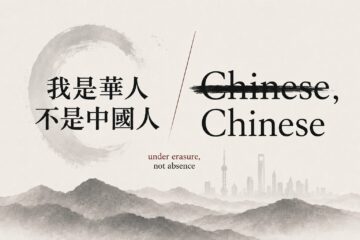
“I Am C̶h̶i̶n̶e̶s̶e̶, Not Chinese”: Some Implications of an Ambiguity and Proposals for Alternatives

Prompted by the meme, “我是華人不是中國人,” and playing on its (machine-) translation into English as “I am Chinese, not Chinese,” this article explores how in English the word “Chinese” ambiguates what are two separately named concepts in Chinese: 華人 (Huaren, referring to Chinese ethnicity) and 中國人 (Zhongguoren, referring to Chinese citizenship).

Read more

Generating power in Taiwan: Nuclear, political and religious power

This paper examines how religion has become increasingly important in Taiwan’s anti-nuclear movement at Gongliao. Originally led by opposition politicians, the movement later shifted toward local religious leadership as public distrust of party politics grew. A Mazu temple emerged as a central force in the protests. The study interprets the conflict as a struggle among three forms of power: nuclear-industrial power, political power, and religious power rooted in local community networks and secular activism.

Read more

Chinese ‘bad death’ practices in Taiwan: Maidens and modernity

In Taiwan’s traditional patrilineal society, ancestral status and a ‘good death’ are granted exclusively to those with male heirs. Unmarried women are consequently excluded from the family lineage, relegating them to the marginalised category of a ‘bad death’. By analysing how families navigate this exclusion—first through private Daoist rituals in pre-modern, rural areas, and later through public Buddhist institutions in modern, urban environments—this study reveals how age-old religious structures continually adapt to broader processes of societal modernisation.

Read more

GENERATION OF A NEW SPACE: A maiden temple in the Chinese religious culture of Taiwan

Excluded from the ancestral lineages that give the Chinese dead a home, women who die unmarried are believed to become restless, polluting ghosts who bring misfortune on their families. At the Sam-giap maiden-temple in northern Taiwan, such spirits are instead ‘adopted’: their incense-ash is carried in red sachets and, once a year, mixed into the temple goddess’s own burner. Drawing on fieldwork begun in 1995, this article shows how the ritual substitutes community for kinship and equality for hierarchy, generating a space in which maiden-spirits are neither ghosts nor ancestors but ‘the disciples of the maiden-goddess’.

Read more

THE FORMATION AND FUNCTION OF THE CATEGORY “RELIGION” IN ANTHROPOLOGICAL STUDIES OF TAIWAN

For decades, anthropologists treated Taiwan as a stand-in for a greater China, and its religious practices as the key to an underlying Chinese essence. This paper traces how the category “religion” came to do that work—signifying the pre-modern, dividing a dynamic West from a static Orient—and how it broke down under the twin critiques of orientalism and of culture as a bounded unit of analysis. It argues that the strength of contemporary approaches lies in treating religion not as a code to be deciphered but as an occasion for place-making and representational practice. A closing interview with Stephan Feuchtwang reflects on over thirty years of writing on religion in China and Taiwan.

Read more